
IndieFest's Inferno: A Hip Hop Opera
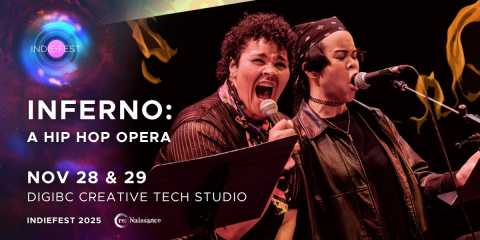
Leading up to the launch of 'Inferno: a Hip-Hopera' by Amy Lee Lavoie and Omari Newton, I
reached the two for an extensive phone interview on their experiences during the project and
their many inspirations and experiences. Minor edits were made for clarity.
Q: Your play applies Dante's Inferno broadly to corporations, which begs the question: Do you
think that corporations are like hell to artists?
Omari: Well, it's complex. I think that largely they end up being sort of a hellscape, but I would
think that ultimately capitalism as a system encourages exponential growth and pleasing
shareholders with profits over everything. It becomes, at best, immoral because without legal
responsibility to protect stakeholder value, you're not thinking about things like ethics or equity.
They'll operate within the bounds of the law, but I don't think the majority of them care about
artists' rights or what's fair.
Amy: We draw inspiration from a few real-life companies in our artistic project. The corporation
that we are using as a placeholder for hell in the show is called Stream.
Omari: It is a streaming service, so everyone is going to make an association with the largest
music service [amongst others]. I think that because we are artists, we saw a streaming service as
a good allegory for how most corporations are predatory in their nature. I remember listening to
an interview with Pharrell Williams where he talked about how 'Happy' was the most-streamed
song in the year it came out, and it was everywhere, and yet he only made a pittance, and I was
like, "How does anyone make money if Pharrell Williams is barely making money for the
biggest song on earth?" The model must be messed up.
Amy: And we do explore the implementation of AI in the industry and in art in general, and how
it's a looming threat for artists. Spotify was recently highlighted in the media because they
platformed an entire AI group that didn't exist, that people were listening to, and people had no
idea that it wasn't a real band.
Omari: And now there's another level of irony where I hear Spotify is suing people because a lot
of people are allegedly using AI to juice their numbers or to create fake bands explicitly for the
algorithm to get views. It's very meta.
Q: You guys have mentioned elsewhere that this is a feminist and anti-capitalist story. What are
the lessons and ideas you want your audience to draw from or take from those perspectives?
Omari: Everything we write is through a feminist lens, and this story deals not only with artist
erasure but the erasure of women and black women in particular. Not that we write things
explicitly with lessons, but a lesson to be taken away is that viewing things through an
intersectional lens means considering a song you love and asking who are the inspirations behind
that song or that genre. Were they credited? Were they or their kin compensated? You see pre-
1950s cases were there are these black artists who wrote and recorded songs, a white performer
or actor was hired to be the face of those songs. The label kept the money, the white artist got the
fame, and the black creators were forgotten from history.
Amy: One of the big things we are exploring is how not to lose yourself and your artistic
integrity in the pursuit of fame. In the face of AI, there's a touchstone in the room that we go
back to, which is "The future is offline." We go back to asking what the positive of AI in artistic
spaces is because it feels very daunting. We have had such amazing conversations with artists
because AI is a tool we can use to produce things in a timeline in a much quicker fashion. We
can get from point A to point B faster, but we are taking out the human part of the literal thought
process. That takes time, getting each note right, and taking the time to ask what we are looking
for. With AI, you can put in really specific prompts and get this really perfect, but sanitized and
soulless version of what you are looking for. We are trying to imbue humanity into this piece and
not lose things while asking if that brings us back to living spaces and community. It brings us
back to why we're doing this in the first place, why we're creating art in the first place.
Q: While you were creating 'Redbone Coonhound, ' you mentioned some racial and cultural
epiphanies. Did anything similar happen in the creation process of 'Inferno '?
Amy: This piece is so intersectional in terms of race, age and how that's dealt with in the play,
culture, gender, and musical genres. So, the intersection of all things is quite extraordinary, and
I've never experienced anything quite like it.
Working intersectionally is supposed to be a little difficult, as it takes the proper space and time
for everyone to feel valued and heard. Again, we are trying to be anti-AI in this space, and we
have to make good on that promise in the act of creation, too. It's taught us a lot, and I feel like
we are in a very meta place with this piece.
Omari had prior relationships with some of the key players and artists in the group, so he brought
them on, and Debbie brought on performers from the opera world. We've just been learning from
each other, and ultimately, we have our touchstones, and as Omari said, we wanted to talk about
the erasure of black women, but it's become bigger than that. The intersection of all that we
talked about, like culture and gender, but also music. There's blues, opera, beatboxing, hip-hop
and pop too.
There's a lot to stick handle, but this is proof that these can all exist in great harmony together on
and off the stage.
Q: In a previous interview, Omari mentioned vocal chord polyps affecting your speech as a
child. How do you think that affected your art?
Omari: Well, as a kid, I'd lose my voice all the time to the point I'd get bullied for having a horse
voice. I think it instilled empathy and humility in me from an early age because I always loved
theatre and wanted to be in school plays. They'd make me be the caterpillar with no dialogue in
Alice in Wonderland, or a tree, because I couldn't speak. It was really frustrating, because I
would see people having a good time on stage with all these lines, and I'd be on the stage in the
corner, not speaking. When I finally had surgery and was able to speak, it was a very joyous
thing, and I was really excited because I had always wanted to do this thing. So that experience
created empathy and gratitude for being a performer.
Q: Before this, Omari, you did "Sal Capone: The Lamentable Tragedy," and then together you
did 'Redbone Coonhound. ' What kind of things did those two works add to 'Inferno?'
Omari: I have been rapping since I was around eight years old, and an MC before I became a
playwright. Even when I stopped MC'ing, I did spoken word and slam poetry, which I still do.
Amy and I were talking yesterday, and we realized that almost every piece we've done has had
elements of Hip-Hop in it. Even Redbone Coonhound, so to me, that sensibility informs all of
my work, and with Inferno being a hip-hop opera, it's all over that piece.
Amy: Right, I think all of our pieces are inherently political and being an interracial couple is a
critical act, or some people perceive it as such. A lot of our work is born from a place of anger,
and this is no different, and I think anger makes great art.
Omari: But also, our weapon against anger is humour.
Amy: Exactly, this is also a little satirical, and there is humour to be mined. With the genre as
well, there is a great tonal shift into a bit more of a serious evolution of the characters as they
make their way through hell, but there is humour, and that is definitely huge.
Omari: In Dante’s original, they travel through the different levels of hell and explore the
different types of sin; in ours, they go through the different floors of this corporate building to
confront this CEO, who is the devil. Each sin is represented by different genres of music. Some
of it is really silly, too. To explore the sin of lust, we used a K-pop style girl group that is singing
a song called "Lookie at my Cookie," which is making fun of super sexual pop songs like [Tate
McRae's] "Sports car" or [Brittney Spears's] "I'm a Slave 4 U."
Amy: I think Omari and I have different takes on this. There's nothing wrong with "Sports Car."
Omari: Listen, I love pop music!
Amy: People legitimately love that song.
Omari: So do I! And "I'm a Slave 4 U" by Brittney has a Pharrell beat, and I love the Neptunes.
Amy: We are talking about a double entendre in terms of these songs. We aren't necessarily
saying that these songs are bad or that highly sexualized things are bad, because we are sex
positive. But I think that the lust for fame and what it costs you in terms of your authentic artistry
is bad.
Omari: And also, a pop song like Tate McRae's "Sports Car," where they use a sports car as a
metaphor for sex, if you zoom out, is inherently funny.
Amy: But I also wonder, because Tate McRae was originally a dancer/singer, what would her
career be like if we took fame out of the equation and Tate McRae was a busker? What would
that version look like? A pared-down YouTube version, pre-fame. There is so much production
involved, and they are slotting Tate McRae into a brand; this is what we are exploring.
Omari: Not that I am a Tate McRae expert.
Amy: You've become one!
Omari: Not yet, at least, wait until I do a PhD on Tate McRae first! From what I know, though,
she was on So You Think You Can Dance first. She's always had her art inextricably linked with
a desire for fame. Her parents brought her to this televised dance show as a kid; there are
YouTube videos of her early on.
Amy: And that's an influence as well; her parents are influencing as well. That's what I mean
about choice, if we can strip all of that away, I wonder what kind of artist Tate McRae would be.
I don't know what kind of artist Tate McRae is without the heavily produced image she has right
now.
Omari: Let's go down this rabbit hole for a second. Justin Bieber, for example, was discovered
busking in Stratford, Ontario, and then Usher saw the video. Remember, when he first came out,
it was all bubblegum pop, 'Baby, blah, blah, blah.' As an adult, he leans on the brothers and is
doing hip-hop, soul and R&B.
There is a level of appropriation there for sure, but clearly, his sensibilities were always leaning
towards that, and they pushed him into this pop box.
Amy: Partly because he was a literal child. Same with Tate McRae, there's such an early
influence and a push in a particular direction, we can wonder about the changes these artists go
through over time. But it's also possible that Tate McRae could want to be the version that she is
right now and producing the music she is making. We don't really give lessons, but we do ask
questions about our work.
Q: As life partners and artistic collaborators, how do you use your life experiences to shape your
work?
Omari: One of the lessons of being married is that you get to experience life and the world
through someone else's lens that you know intimately. I've learned a lot about Amy's perspective,
and it's made me more conscious of my own internalized misogyny, for example. Stuff that when
you are hanging out with the bro's all day, you don't pick up on.
Amy: And vice versa for me and your worldview. We also respect the fact that we will never
fully understand the emotional cost and labour the other person puts in. We can come as close as
we can to understanding through work. For this piece, from a crafts perspective, I am a
traditional playwright. I studied at the National Theatre School. I'm a big structure nut who loves
traditional plays, but Omari comes from a theatre and music background. There are things I've
always wanted to try with him because I’ve always loved his spoken word pieces and his musical
work. We have wanted to do something collaboratively in that medium together, so to do that
together at this level with him is a little dream come true. So there's the learning and the fact that
we get to experience different genres together and dive into things in a way we couldn't do solo.
We can do things with a level of safety. I feel safe to fail with Omari and to explore things and
ask questions. So it's a great thing, but it isn't perfect. We joke about divorce during production
week.
Omari: There's always one day in the creative process, usually during production week, where
we are like, "This is the part where we want to murder each other." But now that we have done
multiple projects, we just acknowledge when we are in that phase.
Amy: It is interesting in that we have done a lot of different genres, from plays to TV and films,
so everything has had its own learning curve. We don't have a set way of starting things, but it's
just fun to work together.
Q: Opera is famously an upper-class European thing, while hip-hop is a younger and more 'street'
or 'urban', what themes or ideas are used to bridge the two?
Omari: I love this question because as you mentioned, the first play I ever wrote was called " The
Lamentable tragedy of Sal Capone" and the title was deliberate because I had always seen hip-
hop and (for lack of a better term) urban music and urban culture, as being equally complex and
on the same level as opera, theatre, and other fine arts. I wanted the title to reflect that. To me,
it's sort of a dream scenario to see hip-hop and opera intertwined on a large stage because I think
that in fine art circles, hip-hop doesn't get the respect it deserves. It's nice to see the genres
blended.
Amy: And they work really well together, which is what we are discovering! Especially in
hip-hop’s sample culture. One of the main features of this is the idea of the song that our
protagonist loses by signing this contract with a streaming service. That song is born from an
opera sample, and we go through the lineage of this song and how it's been taken and used to
inspire artists before being ultimately sampled. The lost and forgotten aspect is very tongue-in-
cheek, I guess.
Omari: I've said a few times that hip-hop is one of, if not the only, genre of music that can be
part of any form of music. You can have hip-hop country, hip-hop opera, because of the
sampling that is inherent to the genre. I remember "Paparazzi" by Xzibit in the 90s had an opera
sample in the chorus.
Amy: I think they're both very heightened forms, and they both have the potential for great
emotional weight, so when we hear them together, it's a really beautiful marriage.
Omari: There are some bangers in this show.
Amy: We don't take responsibility for these bangers! The artists are insane!
Omari: We have to shout out Kimmortal, Teiya Kasahara, Leo DE Johnson, Jessie Hurter (AKA
Scribbly Doodle), and of course Debbie Wong, who is the AD of Renaissance opera and our
collaborator and a musical director.
Amy: And there's our fantastic chorus, including Anushka Kashyap, Brandon Thornhill, Alyssa
Samson, and Scott Walters. It's important to get everyone's name in print!